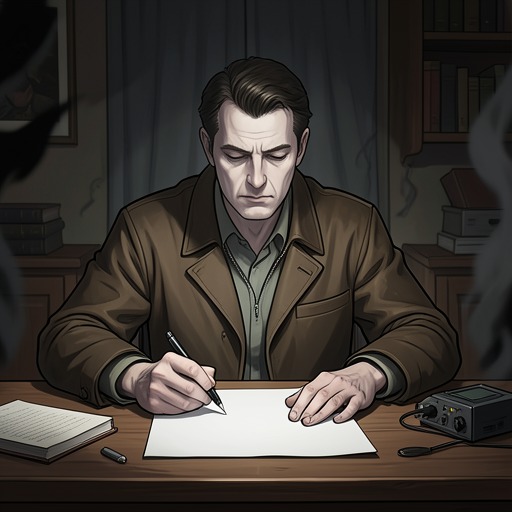
Ben Mears and Mark Petrie
'Salem's Lot: A NovelBen Mears and Mark Petrie are the novel’s core anti-vampire alliance: an adult writer returning to Jerusalem’s Lot and a boy who has already recognized the supernatural threat before the adults around him can name it. Their relationship is decisive because it joins Ben’s capacity to believe, organize, and accept responsibility with Mark’s specialized knowledge, alertness, and willingness to enter danger. The alliance does not merely add a child helper to an adult investigation. It changes who is allowed to understand the crisis and who is capable of directing the response.
Identity and Initial Contrast
Mark first appears as a small, self-possessed boy sitting on Ben’s porch and looking over the town as it slowly resumes its Monday-morning vitality. His economy of manner contrasts with the normal rhythms of the community and with the panic that has begun to surround it. He identifies Ben without hesitation, saying, "You’re Mr Mears," and then gives his name plainly: "My name is Mark Petrie." The meeting establishes Mark not as a passive child waiting to be rescued but as the bearer of urgent information.
The contrast between Mark’s age and his authority is central to the relationship. Earlier, Richie Boddin had treated him as the new schoolboy who needed to be put in his place, targeting him as a supposedly clever, vulnerable outsider. At home, however, Mark’s interests reveal an imaginative world already organized around monsters: he works on a model of Frankenstein’s monster while listening to his parents through the old heating grates, which conduct sound with unusual clarity. Before the supernatural crisis becomes public knowledge, his room is populated by Dracula, the Mad Doctor, Mr Hyde, and other figures of violence. These objects and images do not make Mark responsible for the horror, but they give him a vocabulary with which to recognize it when the monsters cease to be fictional.
The Alliance Begins with Belief
Mark approaches Ben because he has direct knowledge of the vampires’ activity. He reports that Susan Norton has become one of them after Kurt Barlow took her at the house, and he adds that he killed Richard Throckett Straker, though he qualifies the claim with uncertainty: "But I killed Straker. At least, I think I did." The statement combines extraordinary competence with the limits of a child’s evidence and perspective. Mark knows what happened, yet he does not pretend to possess more certainty than the circumstances allow.
He then tells Ben the whole sequence, beginning with the night Danny Glick appeared at his window and ending with the nocturnal visitor who came to him that morning. Danny’s transformation is shown through the boy’s direct encounter with a face turned grave-pale, reddish feral eyes, bloodlike darkness around the mouth, and teeth grown hideously long and sharp. Mark’s account therefore links personal danger to the wider pattern of infection. He is not repeating gossip from the town; he is presenting a chain of witnessed events that forces Ben to revise his understanding of what has happened in Jerusalem’s Lot.
Ben’s answer creates the alliance’s first moral turning point. Asked whether he believes him, Ben says, "Yes," and repeats the word when its full consequence becomes clear. Belief here is not passive sympathy or a comforting gesture. It is an irreversible decision to treat Mark’s testimony as true. Ben immediately identifies the next step: they will visit Matthew Burke, who is in the hospital and has been researching vampires. Mark’s knowledge becomes the basis for adult action, while Ben’s acceptance gives that knowledge public weight.
From Testimony to Joint Action
The partnership develops through a movement from disclosure to command. Once Ben has accepted Mark’s story, he states that after speaking with Matthew Burke they will go to the Marsten House and get the person responsible. The objective is both practical and symbolic: the house is the center from which the town’s corruption radiates, and Kurt Barlow is the enemy behind the transformations. Mark’s report thus produces a concrete plan rather than merely a moment of shared fear.
Mark’s role remains active as the investigation becomes a campaign. He accompanies Ben through the increasingly dangerous work of identifying the vampires, assessing what has happened to Susan Norton, and locating the enemy’s position. When the group prepares to fight, Matthew Burke asks Ben whether he will stay with them and fight with them; the question makes explicit that the alliance is being absorbed into a larger resistance group. Ben’s answer is not treated as an isolated act of heroism. His commitment binds him to Mark and to the other surviving opponents of Barlow.
The alliance also depends on disciplined attention. Before entering the cellar, Mark warns Susan not to look into Barlow’s eyes, turning knowledge of the vampire’s hypnotic power into a rule of survival. He takes Susan’s hand and admits that he is scared and could not do the same thing again. The admission does not cancel his authority; it clarifies its cost. Mark’s courage is not the absence of fear but the ability to continue while fear remains fully present.
The Marsten House and the Division of Labor
The Marsten House becomes the principal testing ground for Ben and Mark’s partnership. Mark and Susan explore the house while planning to kill Barlow, and their movement through the structure places the child at the center of the enemy’s territory rather than safely outside it. The published novel presents the house as still a shambles when Susan looks through a window, while an earlier manuscript version included renovation. That textual difference underscores the house’s unstable status, but in either version it functions as the location where investigation becomes invasion.
When Ben, Mark, Jimmy Cody, and Father Donald Callahan enter the cellar, Barlow greets them through a tape recording in the published version rather than the handwritten note used in the finished novel’s earlier form. The voice turns the cellar into a staged confrontation before the vampire himself is reached. Ben and Mark must therefore proceed through intimidation, darkness, and physical obstacles while holding to the knowledge Mark has supplied. The alliance is not based on a simple division between adult strength and child cleverness; each depends on the other’s capacity to endure the enemy’s attempt to control perception.
Their assault becomes especially concrete when rats have to be chased away before Barlow can be reached. Guns and jugs of holy water become working instruments in the struggle, translating the group’s knowledge of vampire weaknesses into coordinated action. Mark’s presence in this operation confirms his transformation from witness into combatant. He is no longer merely the boy who saw Danny Glick at the window or brought Ben the news about Susan and Straker. He participates in the dangerous sequence by which the remaining defenders attempt to destroy the source of the outbreak.
Trust, Fear, and the Child as Decision-Maker
The relationship’s emotional structure rests on reciprocal trust rather than conventional adult protection. Ben is older, mobile, and able to gather allies, but he cannot begin the final resistance until he accepts Mark’s account. Mark, for his part, approaches Ben because Ben is capable of doing what the town has failed to do: hear the evidence, believe it, and act. Their alliance therefore reverses the usual hierarchy of knowledge. The adult supplies institutional access and physical support; the child supplies perception that has not been neutralized by disbelief.
Mark’s earlier encounter with Danny explains why his later conduct carries unusual force. He has seen the vampire at close range and understands that the familiar child from the town can return as a predator. His warning about Barlow’s eyes is the practical expression of this knowledge. His fear, stated before the cellar descent, also prevents the alliance from becoming a fantasy of childish invulnerability. Mark acts despite terror, while Ben’s belief prevents that terror from being dismissed as imagination.
The town itself provides the negative image of their partnership. Jerusalem’s Lot is laid out around intersecting roads, with Brock Street crossing Jointner Avenue at right angles and the Royal River flattening its eastern boundary; on a map the roads resemble a telescopic sight. Yet the community’s apparent clarity of structure does not produce clear recognition. The Bend contains trailers, junked cars, children, televisions, and makeshift domestic life, while the town generally assumes that nothing truly terrible can happen in such a nice place. Ben and Mark’s alliance cuts through that collective denial. They read the town not as its reassuring surface suggests but as a connected field of roads, houses, graves, windows, and hidden rooms through which danger moves.
Narrative Role and Ending Significance
Ben and Mark’s alliance gives the vampire plot its central ethical shape. The conflict is not won by disbelief, distance, or the preservation of ordinary roles. It begins when Ben accepts the testimony of a child and becomes willing to follow its implications. Mark’s authority grows because his knowledge repeatedly proves actionable: he recognizes the threat, identifies the transformed, warns against Barlow’s gaze, and enters the Marsten House despite understanding what waits below.
The pair also embody the novel’s movement from the private to the collective. Mark’s first report concerns a boy at a window, a woman taken at a house, and a man possibly killed; Ben converts those facts into a visit to Matthew Burke, a decision to fight, and an assault on the Marsten House. In the cellar, the alliance stands alongside Jimmy Cody and Father Donald Callahan, but its distinctive foundation remains the original exchange between the returning adult and the boy who comes to him with bad news.
Their importance lies finally in the reversal they enact. Mark is initially surrounded by adults who could regard him as a schoolboy, a target for bullying, or a child whose fears should be contained. Ben becomes the adult who does not contain the knowledge but receives it. Mark then becomes a decision-maker and fighter, while Ben becomes the protector and organizer who needs the child’s perception in order to proceed. Together they represent the novel’s most effective answer to the town’s complacency: trust the witness, name the evil, and move toward the place from which it operates, even when both partners understand that the next step may be terrifying.